• BME80G Seminar – Susanne Haga, “Ethics of AI in Genomic Medicine”

    Jack Baskin Auditorium 191 Baskin Cir, Santa Cruz, CA

    Presenter: Dr. Susanne Haga, Professor in Medicine @ Duke University About the speaker: Dr. Haga’s research focuses on the translation of genomics into clinical practice. A central theme across her work is education, spanning professional, public, and patient audiences. Her projects have encompassed the development of educational materials on genomic research, pharmacogenetic testing, and the communication of […]

  • NemoClaw NVIDIA x ASUS Hackathon @ UC Santa Cruz

    NemoClaw NVIDIA x ASUS Hackathon @ UC Santa Cruz
    Kresge College R-3 Suites, Santa Cruz, CA

    Welcome to the premier physical AI hackathon on the West Coast. We are bringing together the top 200 AI, infrastructure, and hardware engineers to build autonomous, agentic applications on the NVIDIA NemoClaw stack. ​You aren’t just calling APIs, you are building on enterprise-grade hardware. ​The Tracks: The Edge Track: 40 exclusive teams will be granted […]

  • Bai, G. (BMEB) – Long-read single-molecule chromatin architecture and its role in transcriptome regulation

    Biomedical Sciences Building 575 McLaughlin Drive
    Hybrid Event

    Sequencing technologies have revolutionized our understanding of biology, yet many existing methods require fragmentation of DNA or RNA, fundamentally limiting our ability to study these molecules in their native, intact forms. Long-read sequencing overcomes this constraint by enabling the sequencing of long, single-molecule native DNA and RNA, providing simultaneous access to both sequence and base […]

  • Lucas, J. (BMEB) – Enabling Population-Scale Analysis of Human Centromere Diversity

    Engineering 2 Engineering 2 1156 High Street, Santa Cruz, CA
    Hybrid Event

    Centromeric DNA is critical for accurate chromosome segregation and genome stability, but due to its repetitive nature, it was only recently fully included in a human reference. Rapid evolution and sequence diversity in these regions limit the utility of one reference sequence, however. Integrating centromeric and pericentromeric satellite DNA – which together constitute over 5% […]

  • Annual BE Student Project Showcase

    The annual BE Student Project Showcase celebrates the innovative work and accomplishments of undergraduate engineers in capstone courses and research pathways.

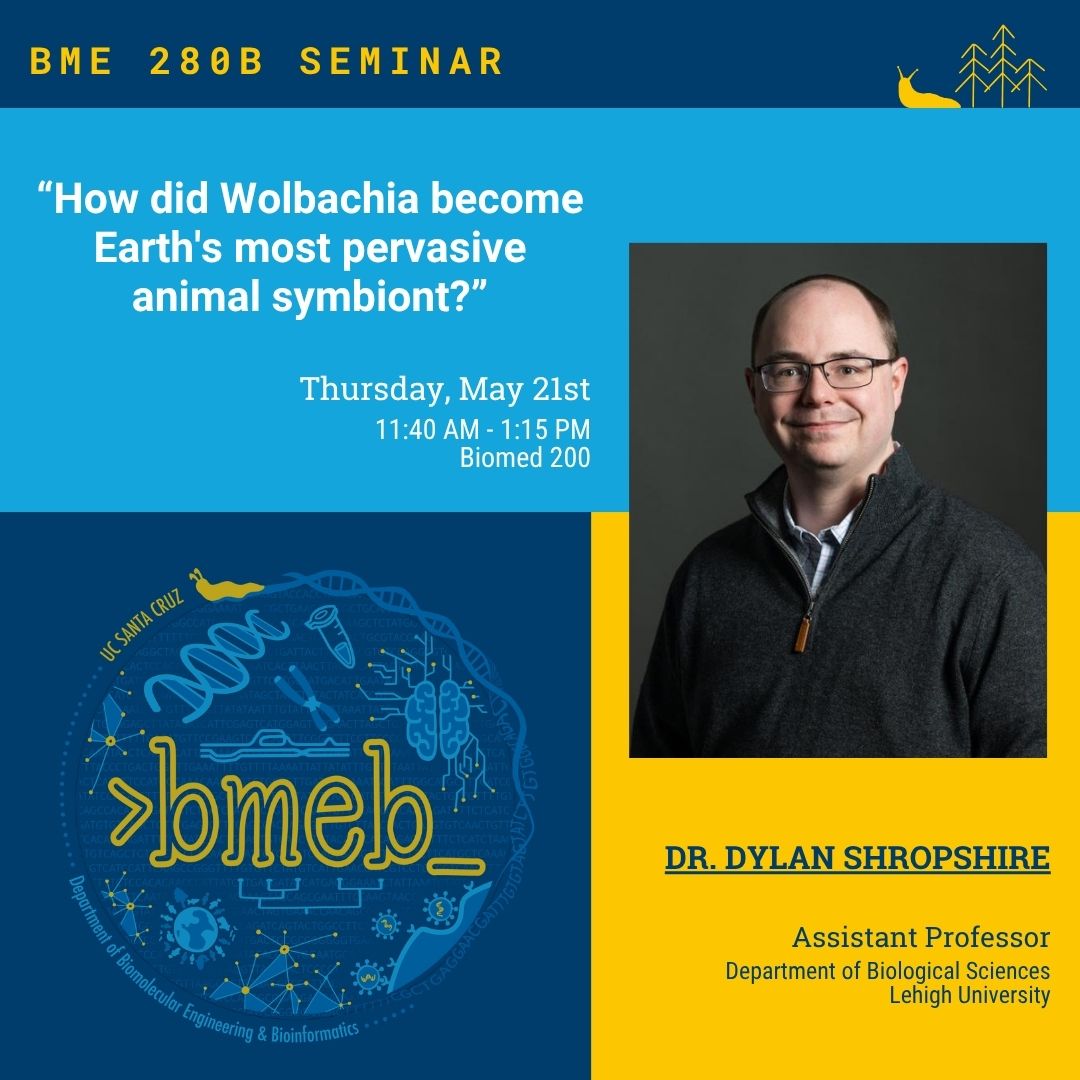
  • BME 280B Seminar: Speaker Dylan Shropshire – “How did Wolbachia become Earth’s most pervasive animal symbiont?”

    Biomedical Sciences Building 575 McLaughlin Drive

    Presenter: Dylan Shropshire, Assistant Professor in the Department of Biological Sciences, Lehigh University Description: Maternally transmitted Wolbachia bacteria inhabit roughly half of all arthropod species, making them likely the most common animal-associated microbe on Earth. Wolbachia alter host reproduction, persist across deep evolutionary timescales, and move into new host species in ways that we are only beginning to resolve. Wolbachia’s […]

  • BME 280B Seminar: 4th Year Grad Talks

    Biomedical Sciences Building 575 McLaughlin Drive

    Please join us for our BME 280B seminar series Thursday (5/28/26) in person at Biomed 200. The event will run from 11:40 AM to 1:15 PM and feature our 4th […]

  • Morey, C. (BMEB) – Innovations in Interdependence: Genomic and Functional Evolution in Invertebrates and Their Intracellular Symbionts

    Biomedical Sciences Building 575 McLaughlin Drive
    Hybrid Event

    Intracellular symbionts are microorganisms, such as bacteria, that live within host cells. These associations are widespread throughout the invertebrate tree of life, and can perform a diversity of key metabolic, immune-response, or other functions that the host is dependent on for survival or reproduction. Intracellular symbioses allow both the host and the symbiont to occupy […]

  • Xu, D. (BMEB) – Interplay Between CENP-A, DNA Methylation, and H3K9me3 in Defining Centromere Identity

    Engineering 2 Engineering 2 1156 High Street, Santa Cruz, CA
    Hybrid Event

    Centromeres ensure proper chromosome segregation during cell division, yet the organization and regulation of centromeric chromatin within satellite DNA arrays remain incompletely understood. Here, we leverage the complete diploid human genome benchmark (T2T-HG002) to provide a detailed study of centromeric sequence and chromatin architecture on individual haplotypes. Using adaptive-sampling-enriched, ultra-long-read DiMeLo-seq, we achieve single-molecule chromatin […]

  • Okamoto, F. (BMEB) – Improving read-to-pangenome alignment in complicated genomic regions

    Engineering 2 Engineering 2 1156 High Street, Santa Cruz, CA
    Hybrid Event

    Many genetics pipelines start by aligning sequencing reads to a reference genome. Aligners attempt to find the position in the reference sequence which best matches the read sequence, but this breaks down when the reads come from a sample with variation relative to the reference. A proposed alternative, pangenome graphs, is supposed to fix such […]

  • BME 280B Seminar: Accelerating the diagnosis of rare diseases using multi-omics

    Biomedical Sciences Biomedical Sciences Building Red Hill Road, Santa Cruz, CA

    Presenter: Stephen Montgomery, Endowed Professor of Pathology, Genetics, Biomedical Data Science, Computer Science, Stanford University   Description: N/A   Bio: Stephen Montgomery is an Endowed Professor of Pathology, Genetics, Biomedical Data Science and, by courtesy, Computer Science at Stanford University. He has trained in multiple countries including Canada, Germany, England, and Switzerland. He is best […]

  • BME80G Seminar – Sheril Kirshenbaum, “Science in Policymaking”

    Jack Baskin Auditorium 191 Baskin Cir, Santa Cruz, CA

    Please note: Following this lecture, the Genomics Institute’s Diversity, Equity, and Inclusion Committee will host a reception on the Baskin Engineering Lanai with Dr. Kirshenbaum where we can continue the discussion on how to effectively engage lawmakers and the public to value and support genomic science. Presenter: Dr. Sheril Kirshenbaum Abstract: Science shapes our world, but meaningful policy engagement […]

  • BME/Genomics Seminar: Supervised and Unsupervised DeepGene Finding and Genome Foundation Models

    Engineering 2 Engineering 2 1156 High Street, Santa Cruz, CA

    Presenter: Mario Stanke, Professor of Bioinformatics, University of Greifswald Description: This talk will explore recent machine learning approaches for eukaryotic genome annotation. Our supervised ab initio deep gene finder, Tiberius, correctly predicts more than four times as many human protein-coding gene structures as its father, Augustus, and in some clades, it approaches the accuracy of […]

  • Calicchio, A. (BMEB) – Comparison of long-read sequencing and analysis methods for transcriptome analysis

    Biomedical Sciences Building 575 McLaughlin Drive
    Hybrid Event

    Alternative splicing, the process generating different RNA isoforms from a single gene, is considered one of the main factors driving increased organism complexity in eukaryotes. Variations in isoform and gene expression produce the functional differences that give rise to different cell types and, in some cases, result in disease. Long-read RNA sequencing has transformed our […]

  • Condon, C. (BMEB) – Genomic conflict across scales

    Biomedical Sciences Building 575 McLaughlin Drive

    Genomes are often viewed as cooperative systems in which genes work together to support organismal function. Yet genetic elements can also act in ways that favor their own transmission or persistence, creating conflict within the genome. In this talk, I examine the evolutionary and functional consequences of such genomic conflict across three systems. First, I […]

  • Penunuri, G. (BMEB) – Genomic, Proteomic, and Computational Approaches to the Study of Host-Microbe Systems

    Biomedical Sciences Building 575 McLaughlin Drive
    Hybrid Event

    Host-microbe systems are core to some of biology’s most consequential interactions, from the pathogens that drive infectious disease to symbionts affecting agricultural pest control and vector-borne disease transmission. Yet unlike the model organisms that have driven most of modern molecular biology, the microbes at the center of these interactions are rarely genetically tractable: many cannot […]