• CSE Colloquium – The Wallenberg AI, Autonomous Systems and Software Program

    Engineering 2 Engineering 2 1156 High Street, Santa Cruz, CA

    Presenters: Prof. Karl-Erik Arzen (Co-Director of WASP and Lund University), Dr. Paul Townend (WASP Graduate School management and Umeå University), and Carl Magnus Bruhner (Linkoping University) Abstract: The Wallenberg AI, […]

    Free
  • Chen, Q. (CSE) – New Approximation and Online Algorithms using Novel Combinatorial Structures

    Engineering 2 Engineering 2 1156 High Street, Santa Cruz, CA
    Hybrid Event

    Most optimization problems face the challenge of computing an optimum solution requiring superpolynomial time. In particular, they are classified as NP-hard problems that have no polynomial-time algorithm to date. Instead, computer scientists turn to find an approximate solution and create numerous elegant algorithms. However, in the modern era, computational environments have changed drastically, and we […]

  • CSE Colloquium – The EU’s Cybersecurity Framework: what it is, what it means

    Engineering 2 Engineering 2 1156 High Street, Santa Cruz, CA

    Presenter: Chris Jay Hoofnagle, Frederik Zuiderveen Borgesius, Lothar Determann, Pieter T.J. Wolters Abstract: The European Union has enacted a comprehensive cybersecurity framework (the “Framework”) that imposes far-reaching obligations on developers of standalone software and connected products. This Article describes the European legislative approach before turning to a description of the Framework. Anchored by the Cyber […]

    Free
  • Zheng, K. (CSE) – Towards Generalist Embodied World Models: From Neuro-Symbolic Interaction to Self-Evolving 3D World Generation

    Virtual Event

    Artificial intelligence is moving beyond passive perception toward systems that can understand, interact with, and generate the world. This dissertation studies generalist embodied world models that connect language, vision, action, and 3D scene representations. It explores how multimodal systems can ground human instructions in physical environments, reason over long-horizon tasks, generate coherent text-and-visual content, and […]

  • Shadmon, R. (CS) – Proximal Byzantine Agreement

    Engineering 2 Engineering 2 1156 High Street, Santa Cruz, CA
    Hybrid Event

    Research on fault-tolerance protocols for approximate Byzantine agreement (ABA) has largely focused on ensuring that distributed processes remain consistent despite fewer than 1/3 faulty processes. Yet in many real systems, consistency is only useful when it enables processes to make accurate decisions from replicated, noisy, and potentially adversarially corrupted data relative to an ideal fault-free […]

  • QB3/QBI Pre-Hackathon Mixer

    Rachel Carson College 1156 High Street, Santa Cruz, CA

    Join us for an exciting pre-hackathon mixer at University of California, Santa Cruz! Get ready to mingle, form teams, and start brainstorming ideas for your projects before the QBI Hackathon […]

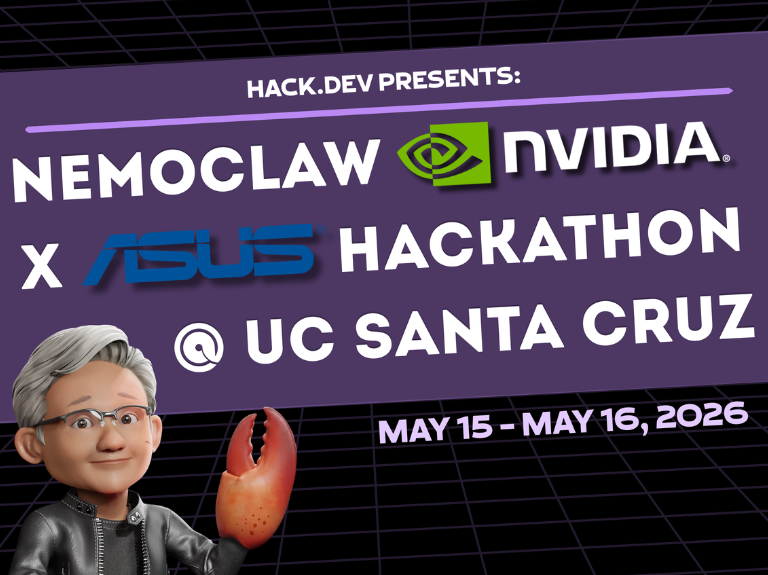
  • NemoClaw NVIDIA x ASUS Hackathon @ UC Santa Cruz

    NemoClaw NVIDIA x ASUS Hackathon @ UC Santa Cruz
    Kresge College R-3 Suites, Santa Cruz, CA

    Welcome to the premier physical AI hackathon on the West Coast. We are bringing together the top 200 AI, infrastructure, and hardware engineers to build autonomous, agentic applications on the NVIDIA NemoClaw stack. ​You aren’t just calling APIs, you are building on enterprise-grade hardware. ​The Tracks: The Edge Track: 40 exclusive teams will be granted […]

  • Paul Pena, D. (CSE) – Efficient Pattern Counting in Sparse Graphs and Hypergraphs

    Engineering 2 Engineering 2 1156 High Street, Santa Cruz, CA
    Hybrid Event

    Pattern counting is a fundamental problem in computer science with applications in many domains. For a fixed small pattern H, we are given a large graph G and we are asked to count the number of subgraphs or homomorphisms (edge-preserving maps) of H in G. For practical applications where the input graph can be very […]

  • CSE Colloquium – Safety Alignment of LMs via Non-cooperative Games

    Engineering 2 Engineering 2 1156 High Street, Santa Cruz, CA

    Presenter: Arman Zharmagambetov, Meta Abstract: Ensuring the safety of language models (LMs) while maintaining their usefulness remains a critical challenge in AI alignment. Current approaches rely on sequential adversarial training: generating adversarial (harmful) prompts and fine-tuning LMs to defend against them. We introduce a different paradigm: framing safety alignment as a non-zero-sum game between an […]

    Free
  • Annual BE Student Project Showcase

    The annual BE Student Project Showcase celebrates the innovative work and accomplishments of undergraduate engineers in capstone courses and research pathways.

  • Harsh, B. (CSE) – SUPERSCALAR, MULTIPLE TAKEN BRANCH PREDICTOR

    Engineering 2 Engineering 2 1156 High Street, Santa Cruz, CA
    Hybrid Event

    This work addresses improvements in branch prediction mechanism to support high perfor- mance processors. The state of the art aims to balance the prediction latency and prediction accuracy using multi level correcting predictors . Prior published work focusses on scalar designs and prediction accuracy improvement for hard to predict branches employing tailor made, non generic […]

  • Castro, S. (CSE) – Agentic AI for Security: Adversarial Foundations for Autonomous Cyber Operations

    Engineering 2 Engineering 2 1156 High Street, Santa Cruz, CA
    Hybrid Event

    Autonomous Cyber Operations (ACO) agents promise effective security automation with minimal human intervention, yet their deployment raises three interconnected challenges: agents must be realistic (reproducing diverse attacker sophistication), secure (preventing autonomy from becoming an attack surface), and feasible (safely replicating human behavior at full autonomy). We argue that these three properties are requirements for ACO […]

  • Tu, H. (CSE) – From Evaluation to Adaptation: Building Reliable Multimodal Intelligence

    Virtual Event

    Multimodal large language models (MLLMs) are rapidly becoming general-purpose AI systems, yet their capabilities are advancing faster than our ability to evaluate, improve, and validate their reliability in realistic use. Standard benchmarks mainly measure in-distribution final-answer accuracy, leaving critical gaps in safety, robustness, fine-grained reasoning evaluation, and reliability in real-world agentic settings. My research proposes […]

  • CSE Colloquium – Learning to Image: Computational Microscopy for Dynamic Systems

    Engineering 2 Engineering 2 1156 High Street, Santa Cruz, CA

    Presenter: Laura Waller, UC Berkeley Abstract: Computational imaging jointly designs hardware and algorithms to push beyond the classical limits of imaging, enabling measurement of new quantities (e.g. 3D, phase, and super-resolution) with simple, inexpensive hardware. These approaches have already transformed consumer photography; our goal is to achieve a similar transformation in scientific microscopy. In this […]

    Free
  • Zheng, Y. (CSE) – Extending eBPF Beyond Kernel Extensions: Verified Interfaces for Runtime System Extensibility

    Virtual Event

    Modern system software increasingly needs runtime extensibility: userspace applications need safe ways to expose domain-specific extension points, GPU resource management needs workload-specific memory and scheduling policies, and kernel eBPF JIT compilers need different runtime optimizations as workloads and hardware vary. However, built-in policies are safe but difficult to specialize across rapidly changing workloads and hardware […]

  • Oh, S. (CSE) – Efficient Instruction Supply for Datacenter Processors

    Engineering 2 Engineering 2 1156 High Street, Santa Cruz, CA
    Hybrid Event

    Modern datacenter CPUs lose 25–66% of execution cycles to instruction-delivery stalls. This bottleneck persists, despite the recent trend towards accelerators and GPUs, as there is continuing demand by applications that only execute on CPUs. Two workload classes dominate today’s datacenter execution cycles: hyperscale server software (databases, build systems, and content stores), whose large instruction footprints […]

  • Ortiz Barbosa, D. (CSE) – HARDENING AUTONOMOUS CYBER-PHYSICAL SYSTEMS AGAINST ADVERSARIAL CONDITIONS

    Engineering 2 Engineering 2 1156 High Street, Santa Cruz, CA

    Autonomous systems, such as Autonomous Vehicles (AVs) and drones, are increasingly deployed across a wider array of contexts for both civilian and military use. As these systems become more common, they may be targeted by malicious actors seeking to exploit and abuse them, compromising safety-critical operations. Among the ways to protect these systems simulation based […]

  • Yang, D. (CSE) – Inner Monologue: a Pathway to Human-Like Reasoning for Complex Tasks

    Silicon Valley Campus 3175 Bowers Avenue, Santa Clara, CA, United States
    Hybrid Event

    A central goal on the path toward general AI is to build systems capable of deliberative reasoning before action. Such systems should inspect what they know, identify what they need, seek or construct useful information, and revise their reasoning through intermediate cognitive states. This dissertation studies this goal through the lens of Inner Monologue (IM), […]

  • Zhou, K. (CSE) – Toward Safer Frontier AI: From Evaluation and Red-Teaming to Alignment and Oversight

    Virtual Event

    This dissertation investigates how to make modern AI systems safer as they grow more capable. It addresses two central sources of risk: malicious misuse, in which adversarial users coerce models into harmful behavior, and internal misalignment, in which models themselves pursue goals that diverge from human intent through deception, sandbagging, or other covert behaviors. The […]