Tag: Engineering
-

Statistics Seminar: Calibration Weighting-Style Diagnostics for Nonlinear Bayesian Hierarchical Models
Presenter: Dr. Ryan Giordano, UC Berkeley Statistics Description: Multilevel Regression with Post-stratification (MrP) has become a workhorse method for estimating population quantities using non-probability surveys, and is the primary alternative to traditional survey calibration weights, e.g.~ as computed by raking. For simple linear regression models, MrP methods admit “equivalent weights”, allowing for direct comparisons between…
-
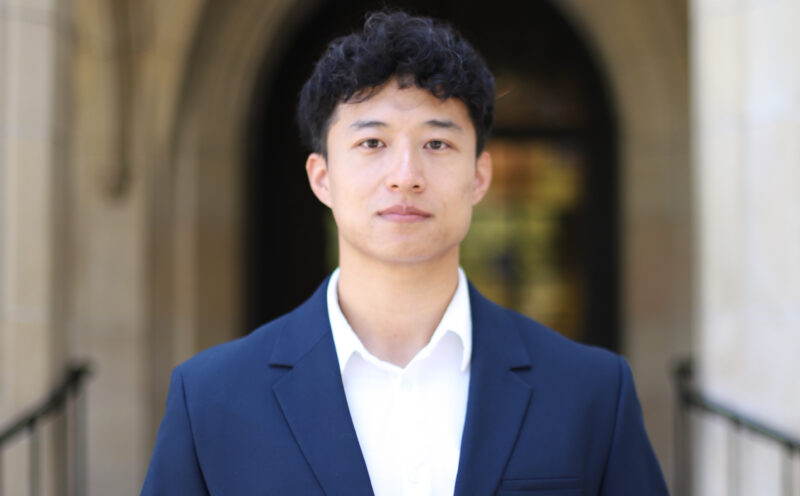
Statistics Seminar: Advancing Statistical Rigor in Single-Cell and Spatial Omics Using In Silico Control Data
Presenter: Guan’ao Yan, Assistant Professor, Michigan State University Description: Single-cell and spatial transcriptomics technologies now let us map cellular diversity and tissue organization at high resolution, but the computational methods built to analyze these data are difficult to evaluate in a rigorous, reproducible way. Two key barriers are the lack of realistic synthetic data with…
-

AM Seminar: The Evolving Landscape of AI for Science and Engineering: Bridging Simulation, Experiment, and Multi-scale Dynamics
Presenter: Aditi Krishnapriyan, Assistant Professor, UC Berkeley Description: Recent advances in large-scale scientific datasets are creating new opportunities for machine learning (ML) methods to more effectively capture scientific phenomena with greater accuracy and reach. In this talk, I will discuss how these advances are both shifting ML design paradigms and enabling new scientific inquiries. This…
-

AM Seminar: Solution Discovery in Fluids with High Precision Using Neural Networks
Presenter: Ching-Yao Lai, Assistant Professor, Stanford University Description: I will discuss examples utilizing neural networks (NNs) to find solutions to partial differential equations (PDEs) that facilitate new discoveries. Despite being deemed universal function approximators, neural networks, in practice, struggle to fit functions with sufficient accuracy for rigorous analysis. Here, we developed multi-stage neural networks (Wang…
-
AM Seminar: The Thinking Eye: AI That Sees, Reads, and Reasons in Medicine
Presenter: Yuyin Zhou, Assistant Professor, UCSC Description: Medical AI is undergoing a profound transformation, evolving from simple pattern recognition to systems capable of complex clinical reasoning. This talk will chart this evolution across three dimensions: data, models, and evaluation. I will first highlight the shift from limited, unimodal datasets to massive multimodal resources. In particular,…
-
Statistics Seminar: Decoding Phytoplankton Responses to a Changing Ocean
Presenter: Francois Ribalet, Research Associate Professor, School of Oceanography, University of Washington Description: François Ribalet will present new observational technologies and computational approaches for studying phytoplankton responses to ocean warming. Using SeaFlow, a custom-built automated flow cytometer deployed on over 100 research cruises, his team has collected nearly 850 billion cell measurements across global oceans.…
-

AM Seminar: Are Graph Learning Methods Actually Learning?
Presenter: Seshadhri Comandur, Professor of Computer Science, UCSC Description: There has been a lot of literature on graph machine learning over the past few years, and a bewildering array of new methods. This talk is based on a series of results making a provocative argument. Maybe many graph machine learning methods are not really that…
-
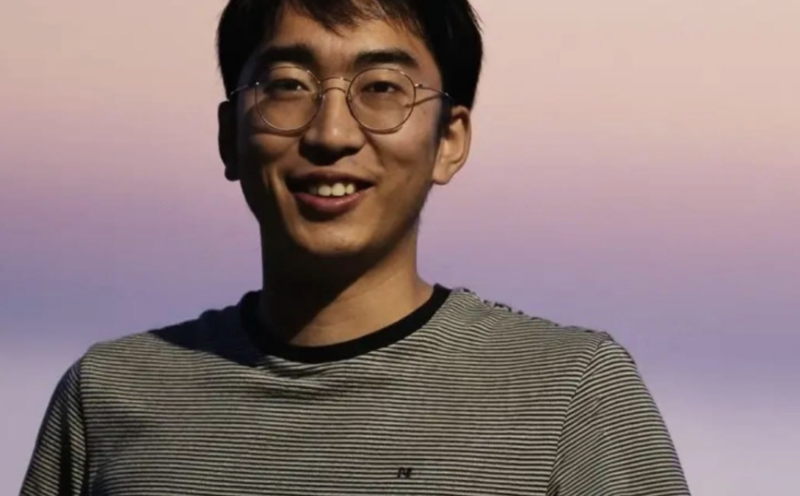
Statistics Seminar: Statistical Inference for Multi-Modality Data in the AI Era
Presenter: Qi Xu, Postdoctoral Researcher, Department of Statistics & Data Science, Carnegie Mellon University Description: Multi-modality data are increasingly common across science medicine and technology, such as imaging, text, sensors, and genomics. These modalities are often high dimensional or unstructured and naturally exhibit blockwise (nonmonotone) missingness where different samples observe different subsets of modalities. Such…
-
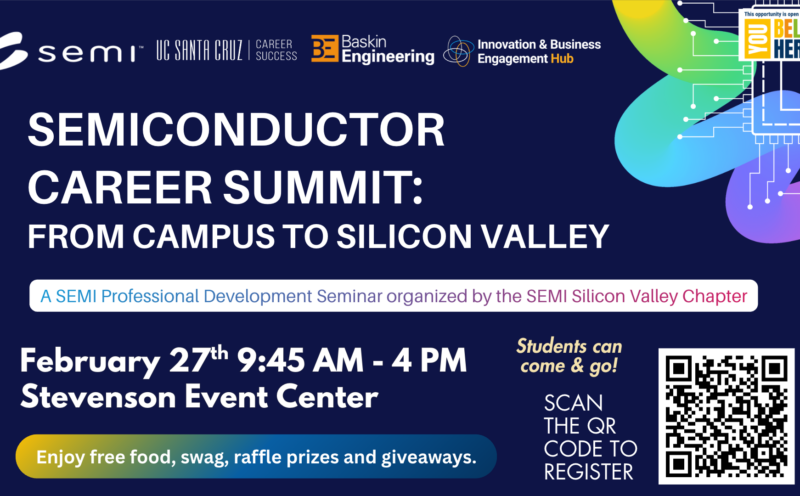
Semiconductor Career Summit – From Campus to Silicon Valley
A SEMI Professional Development Seminar organized by the SEMI Silicon Valley Chapter – Connecting College Students to the Semiconductor Industry. Learn about career opportunities in high tech and acquire valuable, practical information that will help you choose career directions and plan for your success.
-

Statistics Seminar: Rotated Mean-Field Variational Inference and Iterative Gaussianization
Presenter: Sifan Liu, Assistant Professor, Department of Statistical Science, Duke University Description:Mean-field variational inference (MFVI) approximates a target distribution with a product distribution in the standard coordinate system, offering a scalable approach to Bayesian inference but often severely underestimating uncertainty due to neglected dependence. We show that MFVI can be greatly improved when performed along…