• Morey, C. (BMEB) – Innovations in Interdependence: Genomic and Functional Evolution in Invertebrates and Their Intracellular Symbionts

    Biomedical Sciences Building 575 McLaughlin Drive
    Hybrid Event

    Intracellular symbionts are microorganisms, such as bacteria, that live within host cells. These associations are widespread throughout the invertebrate tree of life, and can perform a diversity of key metabolic, immune-response, or other functions that the host is dependent on for survival or reproduction. Intracellular symbioses allow both the host and the symbiont to occupy […]

  • BME 280B Seminar: 4th Year Grad Talks

    Biomedical Sciences Building 575 McLaughlin Drive

    Please join us for our BME 280B seminar series Thursday (5/28/26) in person at Biomed 200. The event will run from 11:40 AM to 1:15 PM and feature our 4th year grad talks. 11:40AM – 11:50AM: Ivana Pacar 11:53AM – 12:03PM: Jesus Gonzalez Ferrer 12:06PM – 12:16PM: Connor Mattingly 12:19PM – 12:29PM: Samira Vera 12:32PM – 12:42PM: Nick Chu 12:45PM […]

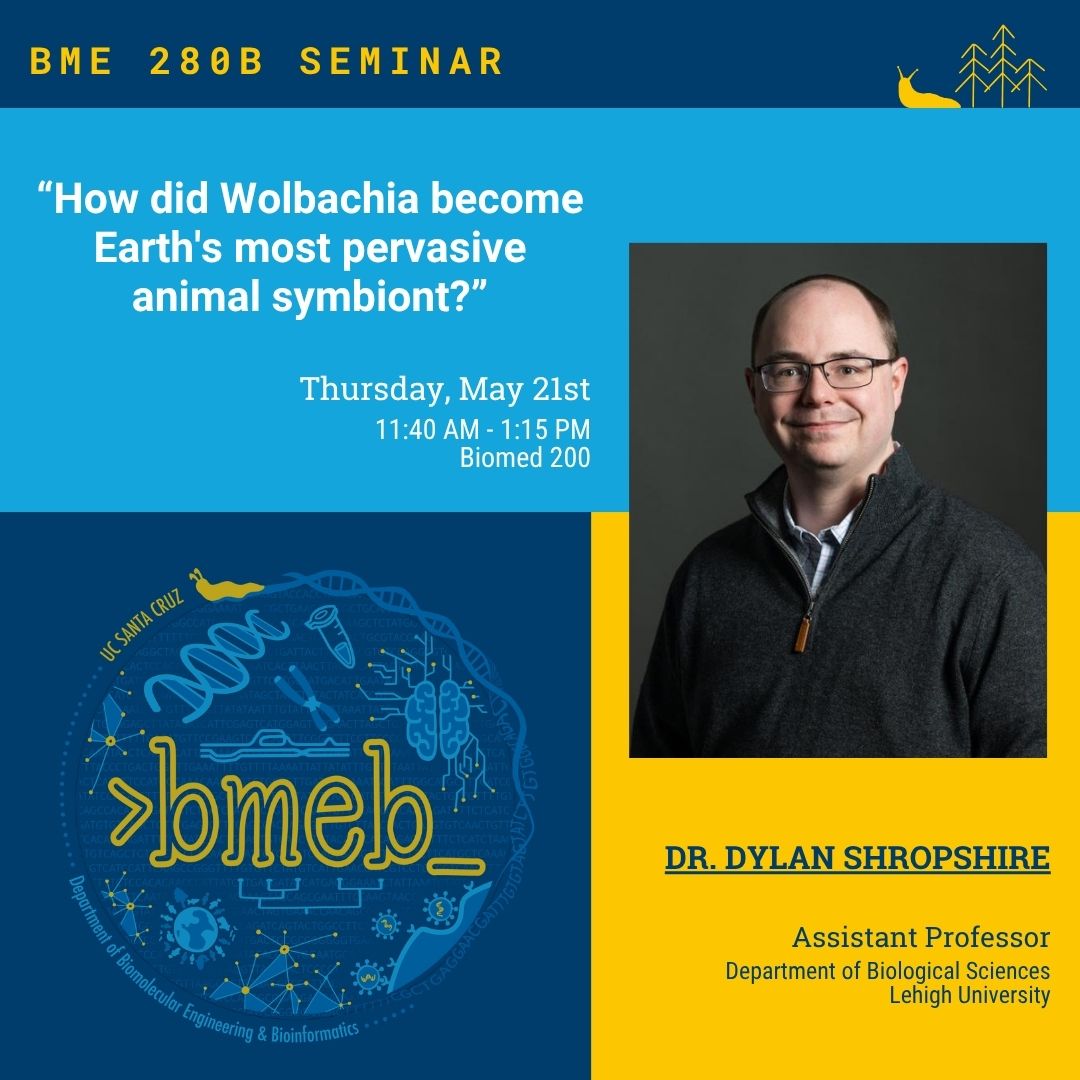
  • BME 280B Seminar: Speaker Dylan Shropshire – “How did Wolbachia become Earth’s most pervasive animal symbiont?”

    Biomedical Sciences Building 575 McLaughlin Drive

    Presenter: Dylan Shropshire, Assistant Professor in the Department of Biological Sciences, Lehigh University Description: Maternally transmitted Wolbachia bacteria inhabit roughly half of all arthropod species, making them likely the most common animal-associated microbe on Earth. Wolbachia alter host reproduction, persist across deep evolutionary timescales, and move into new host species in ways that we are only beginning to resolve. Wolbachia’s […]

  • Bai, G. (BMEB) – Long-read single-molecule chromatin architecture and its role in transcriptome regulation

    Biomedical Sciences Building 575 McLaughlin Drive
    Hybrid Event

    Sequencing technologies have revolutionized our understanding of biology, yet many existing methods require fragmentation of DNA or RNA, fundamentally limiting our ability to study these molecules in their native, intact forms. Long-read sequencing overcomes this constraint by enabling the sequencing of long, single-molecule native DNA and RNA, providing simultaneous access to both sequence and base […]

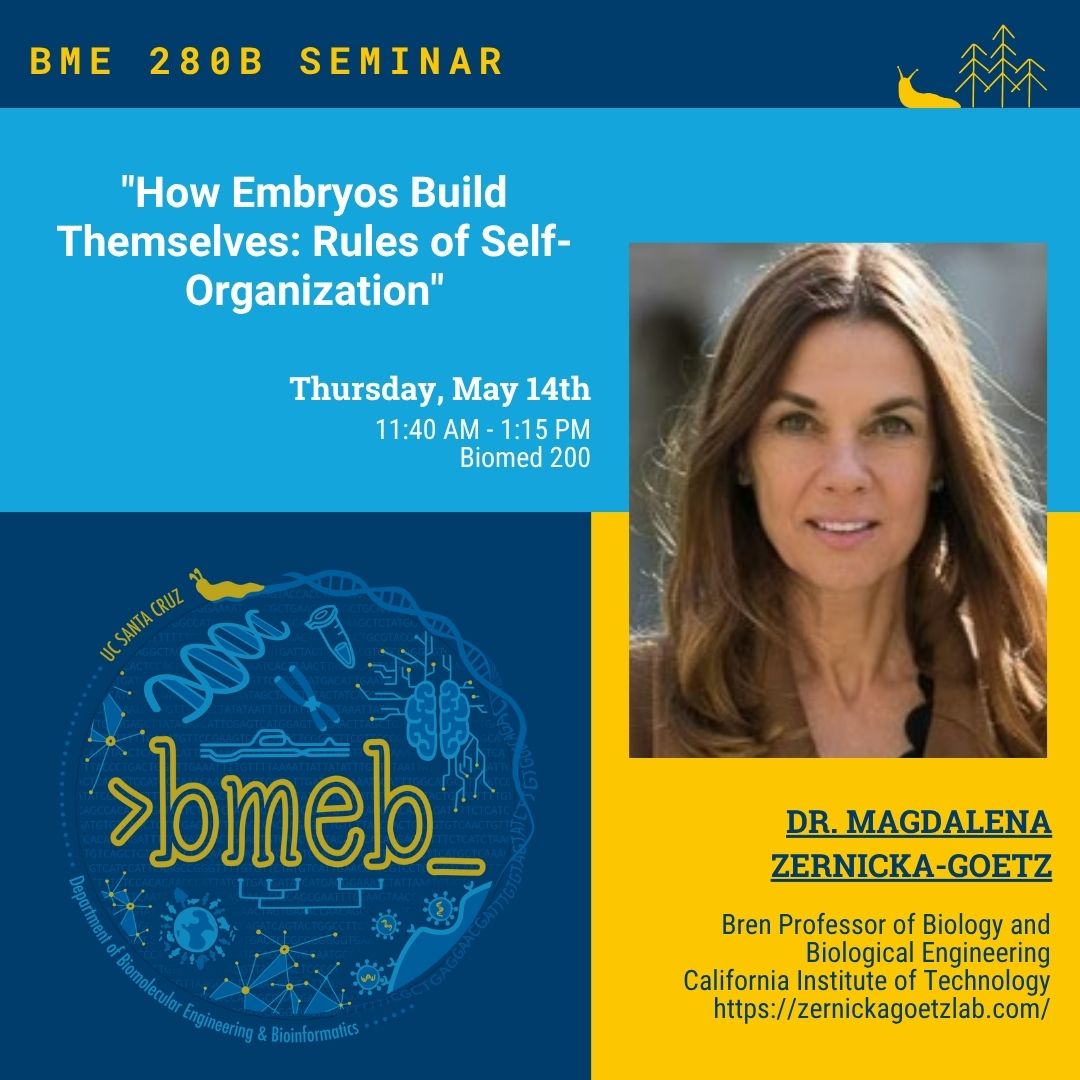
  • BME 280B Seminar: Speaker Dr. Magdalena Zernicka-Goetz – “How Embryos Build Themselves: Rules of Self-Organization”

    Biomedical Sciences Building 575 McLaughlin Drive

    Presenter: Dr. Magdalena Zernicka-Goetz, Bren Professor of Biology and Biological Engineering, California Institute of Technology Description: N/A Bio: Magdalena Zernicka-Goetz is a Bren Professor of Biology and Biological Engineering at the California Institute of Technology. Over the past 25 years, the Zernicka-Goetz Lab has pioneered key discoveries in early mammalian development, including the first studies […]

  • BME 280B Seminar: 4th Year Grad Talks

    Biomedical Sciences Building 575 McLaughlin Drive

    Please join us for our BME 280B seminar series Thursday (5/7/26) in person at Biomed 200. The event will run from 11:40 AM to 1:15 PM and feature our 4th year grad talks. 11:40AM – 11:50AM: Jodie Jacobs Topic/Title: Impact of Wolbachia infection on host gene expression in pseudotime 11:53AM – 12:03PM: Ariana Cisneros Topic/Title: Engineering tunable […]

  • BME 280B Seminar: Small changes, Big consequences: Modulators of Alphavirus Assembly

    Biomedical Sciences Building 575 McLaughlin Drive

    Presenter: Dr. Suchetana (Tuli) Mukhopadhyay, Professor, Indiana University Description: N/A Bio: Suchetana “Tuli” Mukhopadhyay, Ph.D., is a professor in the Department of Biology at Indiana University, Bloomington. She received her B.A. in chemistry from DePauw University and her Ph.D. in chemistry from the University of Illinois at Chicago. Following her doctoral studies, Mukhopadhyay conducted postdoctoral […]

  • Tran, L. (BMEB) – Polysome Shadowing: A Long-Read Sequencing Approach to Study Translation

    Biomedical Sciences Building 575 McLaughlin Drive

    Translation is a central and highly regulated step of gene expression, yet there are few quantitative, high-throughput tools to study translation. Existing methods such as sucrose gradients provide only bulk ribosome counts, while Ribo-Seq offers positional information in the genome but destroys long-range structure and transcript expression information. Because of these limitations, many fundamental questions […]

  • Shanks, C. (BMEB) – Development and Application of Local Ancestry Methods for Population Genomics

    Biomedical Sciences Building 575 McLaughlin Drive

    Local ancestry methods classify the segments of DNA inherited from a specific ancestry (e.g., African, East Asian, European), improving analyses of admixed populations. Aim 1 applies ancestry-specific analysis to more than 1000 whole genome sequences across Polynesia, revealing strong bottlenecks in the voyagers who settled both Hawaiʻi and Rapa Nui, and confirming frequencies of Mendelian […]

  • Leavitt, J. (BMEB) – Evolutionary Dynamics, Functional Adaptations in Stress Response, and Direct Detection of tRNA modifications in Archaea

    Biomedical Sciences Building 575 McLaughlin Drive

    Transfer RNA (tRNA) modifications are essential for structural integrity, decoding fidelity, and stress adaptation, yet their dynamics across phylogenetically distinct archaeal species and their functional roles during stress remain incompletely understood. This dissertation aims to address some of these gaps through a multi-scale investigation that spans the evolutionary dynamics, stress-responsive functions, and direct detection of […]

  • Katte, P. (BMEB) – Interactive and Scalable Frameworks for Pathogen Surveillance and Ancestral Recombination Graph

    Biomedical Sciences Building 575 McLaughlin Drive

    The explosive growth of genomic data, driven by advances in sequencing and inference technologies, presents both an opportunity and a challenge for evolutionary biology and public health. Existing visualization and analysis tools often fall short in handling the scale, complexity, and uncertainty of modern genomic datasets—especially in the areas of pathogen surveillance and ancestral recombination […]