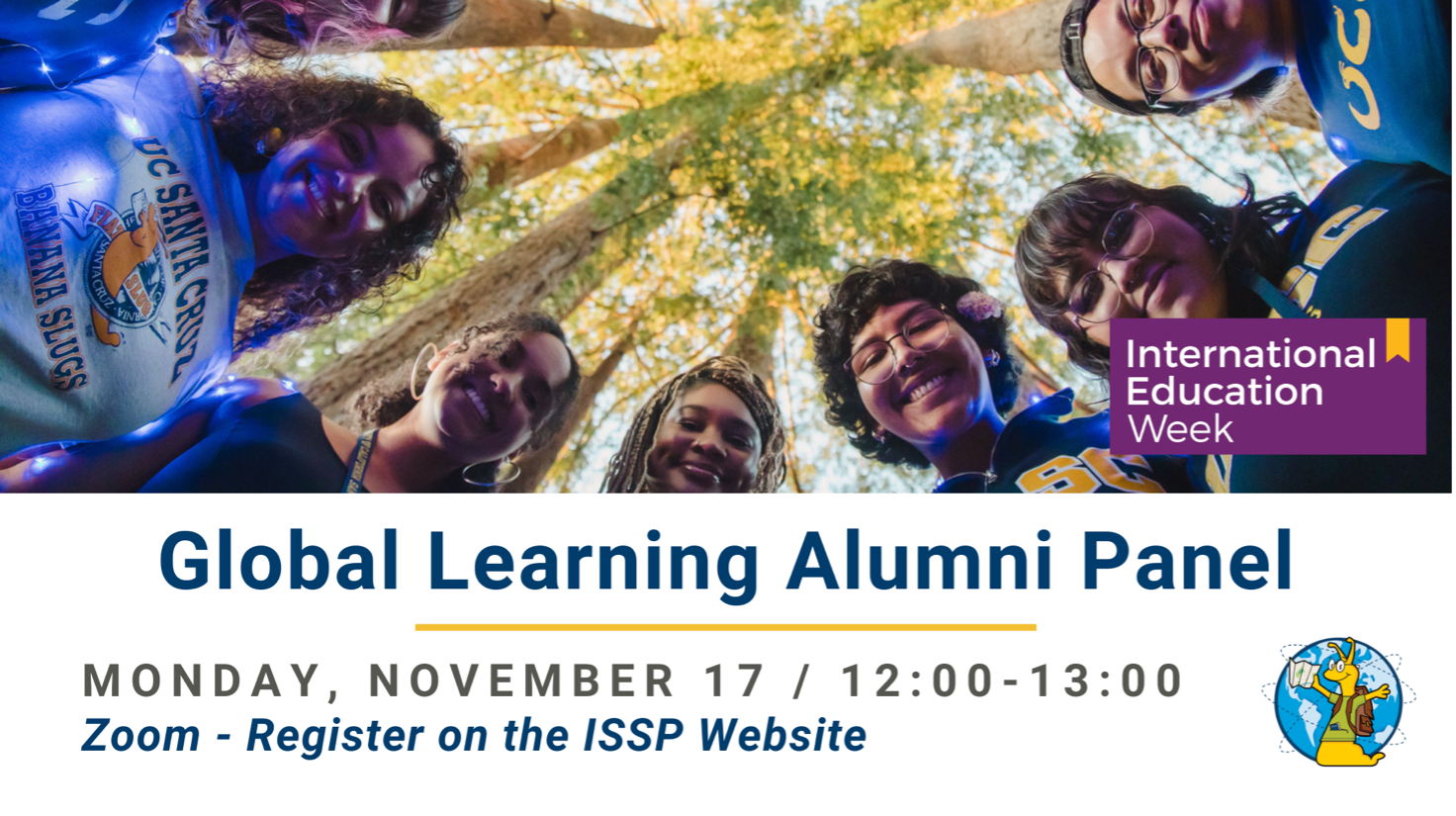
Global Learning Alumni Panel: Study Abroad & Away Experiences
Have you ever wondered what it’s like to study abroad or participate in a domestic study away program? Join us for a virtual alumni panel where past participants of global […]
Have you ever wondered what it’s like to study abroad or participate in a domestic study away program? Join us for a virtual alumni panel where past participants of global […]
Presented by: Linda Hirsch Description: “Games and playful interventions have been researched to increase awareness of climate change impacts and educate about mitigation and adaptation measures. However, besides increased awareness, what real-life impact and adapted behaviors can we actually observe from such interventions? In this talk, I will reflect on the differences between short-term […]

Presenter: Dr. Paula Wulff, UCLA Description: Our solar system hosts six unique planetary magnetic fields. Intrinsic magnetic fields are generated deep inside planets by dynamo action. This process requires regions of electrically conducting material and energy sources to maintain the dynamo. Thus, we can learn about the deep interiors of planets, including their structures and […]

Presenter: Hanna Kim, Assistant Professor, Psychology Department, UCSC Description: Understanding how an intervention works is a central question in behavioral and social research, following the demonstration of its overall effect. Traditional mediation analysis techniques often assume a homogeneous mechanism of effects, overlooking both validity concerns and subgroup variation in causal pathways. In this talk, I […]
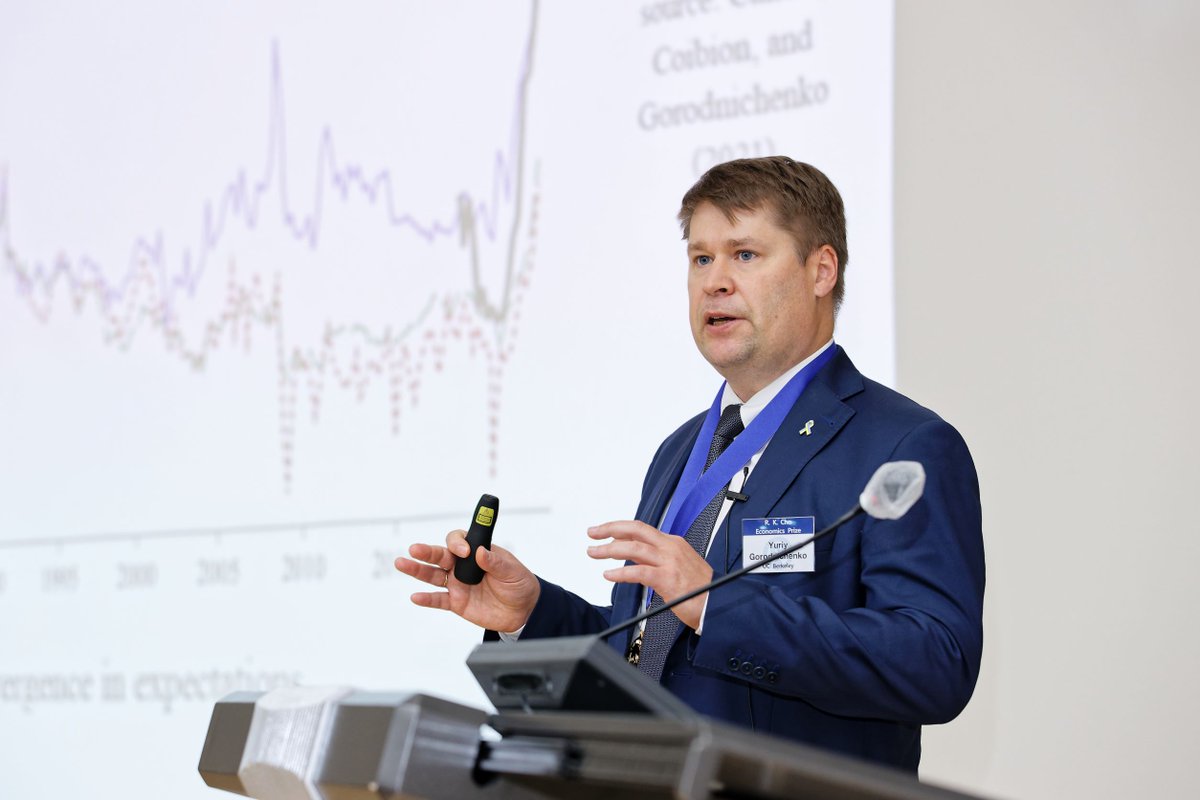
Macroeconomics and International Finance Seminar: Yuriy Gorodnichenko
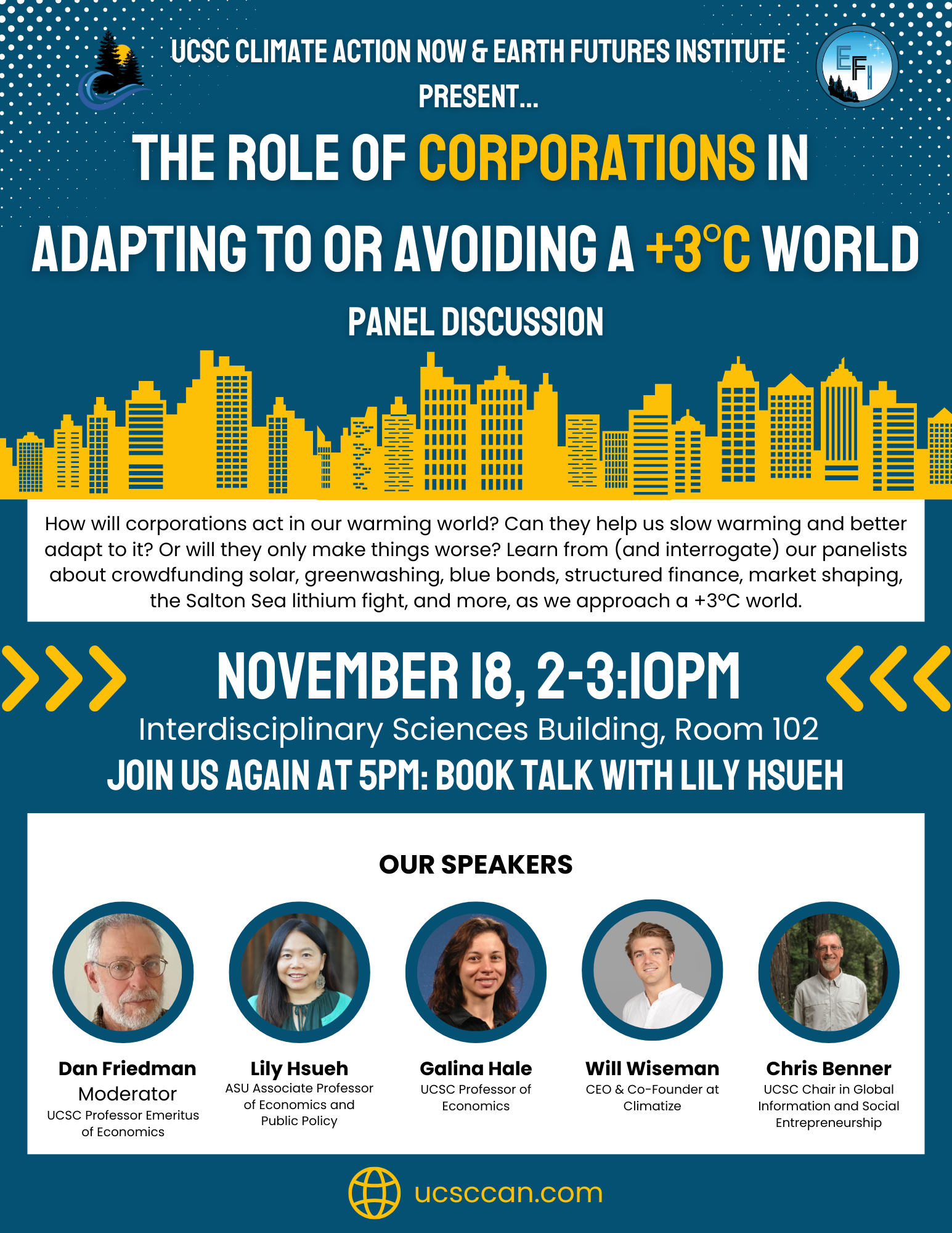
2-3:10 PM Tues Nov 18 in Interdisciplinary Sciences Building Room 102 THE ROLE OF CORPORATIONS IN ADAPTING TO OR AVOIDING A +3ºC WORLD How will corporations act in our warming world? Can they help us slow warming and better adapt to it? Or will they only make things worse? Learn from (and interrogate) our panelists about […]
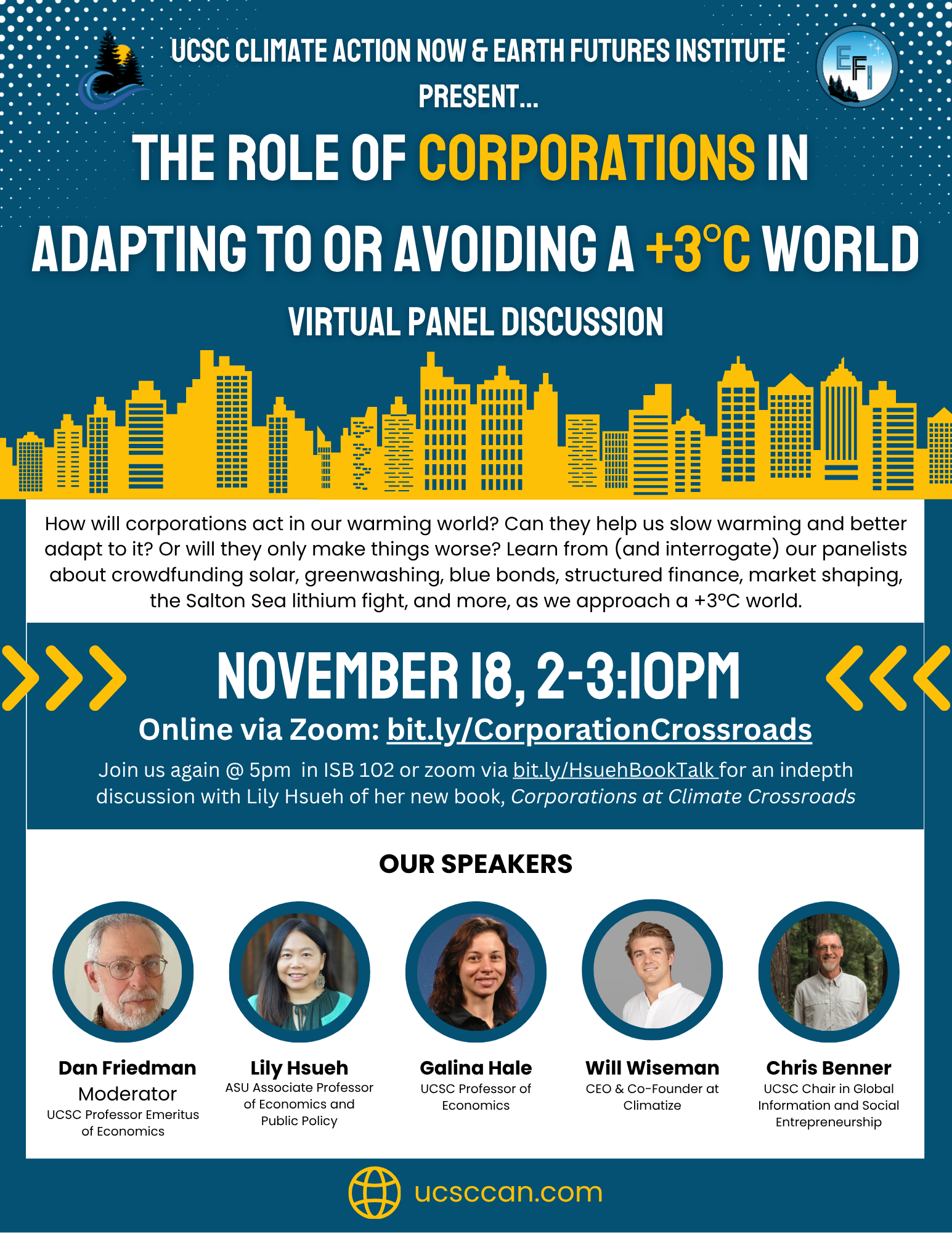
THE ROLE OF CORPORATIONS IN ADAPTING TO OR AVOIDING A +3ºC WORLD PANEL DISCUSSION 2-3:10 pm Tues Nov 18 via ZOOM @ bit.ly/CorporationCrossroads How will corporations act in our warming world? Can they help us slow warming and better adapt to it? Or will they only make things worse? Learn from (and interrogate) our panelists about […]

With climate risks growing, climate action facing political headwinds in many countries, and international cooperation increasingly challenged, Lily Hsueh’s Corporations at Climate Crossroads illuminates how and under what conditions the world’s largest corporations have taken proactive action on climate change during the years leading up to and after the Paris Agreement. Drawing on insights from […]

Presenter: Ranjit Jhala, UCSD Abstract: Rust has risen as a language of choice for new systems code — from OS kernels to hypervisors, firmware and run-times — as it is memory […]

One of the central challenges in quantum computing is finding or approximating the ground-state energy of a local Hamiltonian, a quantum analogue of classical constraint satisfaction problems (CSPs). Among these, the Quantum Max-Cut problem serves as a canonical example, paralleling the classical Max-Cut problem. Despite its foundational importance in both theoretical computer science and condensed […]

@ucsc_isp

Join Dean PK Agarwal for this free, in-person and online event as he provides actionable tips on navigating today’s dynamic job market — from leveraging LinkedIn and digital portfolios to networking effectively and positioning yourself as a must-hire candidate. Ideal for career changers, recent grads, and mid-career professionals. In this session you’ll: Learn proven strategies […]

Join us for the 15th annual Morton Marcus Poetry Reading, featuring honored guest Ellen Bass. Poet Gary Young will host the program, and the evening will include an announcement of the winner of the Morton Marcus Poetry Contest (recipient receives a $1,000 prize). Ellen Bass’s most recent collection, Indigo, was published by Copper Canyon Press in […]
Miniaturized spectrometers have the potential to replace bulky and expensive benchtop models. We have previously demonstrated a multimode interference (MMI) waveguide-based spectrometer that achieves high performance while minimizing its footprint. In this talk, the integration of the MMI spectrometer into an optofluidic device is proposed. This integration opens up applications such as the detection of […]
Organoids are three-dimensional tissue cultures that model real organs and serve as valuable tools for studying development, disease, and treatment response. Traditional methods, which rely on manual handling and incubators, limit consistency and real-time monitoring. To address these issues, we developed a modular microfluidic platform that integrates automated feeding, live fluorescence imaging, and environmental control […]

Spontaneous human combustion! Evil lawyers! Detectives! Family intrigue! Join the Pickwick Club for a series of discussions about ‘Bleak House.’

Most optimization problems face the challenge of computing an optimum solution requiring superpolynomial time. In particular, they are classified as NP-hard problems that have no polynomial-time algorithm to date. Instead, computer scientists turn to find an approximate solution and create numerous elegant algorithms. However, in the modern era, computational environments have changed drastically, and we […]

Presenter: Joey Sankman, Analog/Power Designer, Analog Devices Description: With the rising interest in edge computing, and the addition of AI/ML functionality, nanopower circuits are in great demand to reduce the quiescent power consumption of remote sensors. In this tutorial, fundamental building blocks for nanopower circuits will be covered, including startup-less low-voltage references, low-frequency clocks, and […]
Presenter: Professor Andy Moore, UCSC Ocean Sciences Description: Linear inverse models have enjoyed considerable popularity in the geosciences, particularly in the arena of climate research and climate prediction, for several decades as a straightforward approach to dimension reduction and streamlining computational efficiency. The most common approach is to truncate the system by retaining the leading […]

Macroeconomics and International Finance Seminar: Helen Popper