• Wildlife Cameras and Other Methods for Assessing Backyard Biodiversity

    Hay Barn 94 Ranch View Road, Santa Cruz, CA, United States

    Home gardens, small farms, and wildland-agricultural interfaces can often be areas of increased water, food, and habitat resources for wildlife. Many people are interested in seeing wildlife on their properties, […]

    $20 – $30
  • Le, A. (STAT) – Bayesian Nonparametric Analysis of Densities for Replicated Point Patterns

    Virtual Event

    Many scientific applications produce repeated point pattern realizations across subjects, regions, or time. While such point patterns exhibit individual variation, we assume they arise from related point processes that share a common distributional structure. This dissertation develops a Bayesian nonparametric modeling framework built around an interpretable baseline. We work with Poisson processes, such that the […]

  • Zhao, Z. (CSE) – TOWARD VERIFIABLE REASONING IN LLMS

    Silicon Valley Campus 3175 Bowers Avenue, Santa Clara, CA, United States
    Hybrid Event

    Chain-of-thought (CoT) prompting can improve final-answer performance, but it does not guarantee that intermediate reasoning steps are faithful, valid, or checkable. This proposal studies how formal methods can make natural-language reasoning more reliable by translating CoT rationales into Lean artifacts, checking the resulting theorem statements and proofs, and using compiler feedback to diagnose and repair […]

  • August Slugs and Steins with Professor Barbara Rogoff

    Virtual Event

    Learning to be Community-Minded How do children learn to be part of a community, attentive to what’s going on around them and pitching in to help out? Barbara Rogoff builds on her 50+ years researching and participating with a Mayan community in Guatemala to make the case that people everywhere can learn from Indigenous cultural […]

  • Chat with the AI Chair

    Silicon Valley Campus 3175 Bowers Avenue, Santa Clara, CA, United States

    AI is advancing faster than ever. Join Praveen Krishna, chair of the AI Program Advisory Board, for a discussion of the latest developments shaping the field, from Agentic AI and AI orchestration to enterprise deployment, emerging regulations, local AI models, and breakthrough innovations. This is a monthly conversation series. Each session highlights timely trends and concludes […]

  • Krishnaswamy, L. (CSE) – Network Load Balancing for Geographically Distributed Datacenters

    Engineering 2 Engineering 2 1156 High Street, Santa Cruz, CA
    Hybrid Event

    As datacenters scale up and become more geographically distributed, wide-area network inter-datacenter traffic, which typically consists of data-heavy tasks, has become increasingly prevalent. Some of the noteworthy challenges raised by the coexistence and interaction between inter- and intra-datacenter traffic are the differences in their QoS requirements, link utilization, and round-trip times. To the best of […]

  • Aliamooei Lakeh, S. (ECE) – Optimization and Decision-Support Frameworks for Resilient Power Systems Under Large-Scale Electrification

    Virtual Event

    The rapid electrification of transportation is creating new interdependencies between power and transportation systems, particularly during extreme events and disasters. As electric vehicle (EV) adoption increases, evacuation-related charging demand, infrastructure disruptions, and limited access to energy resources introduce challenges that conventional power system planning and operation frameworks were not designed to address. Wildfires provide a […]

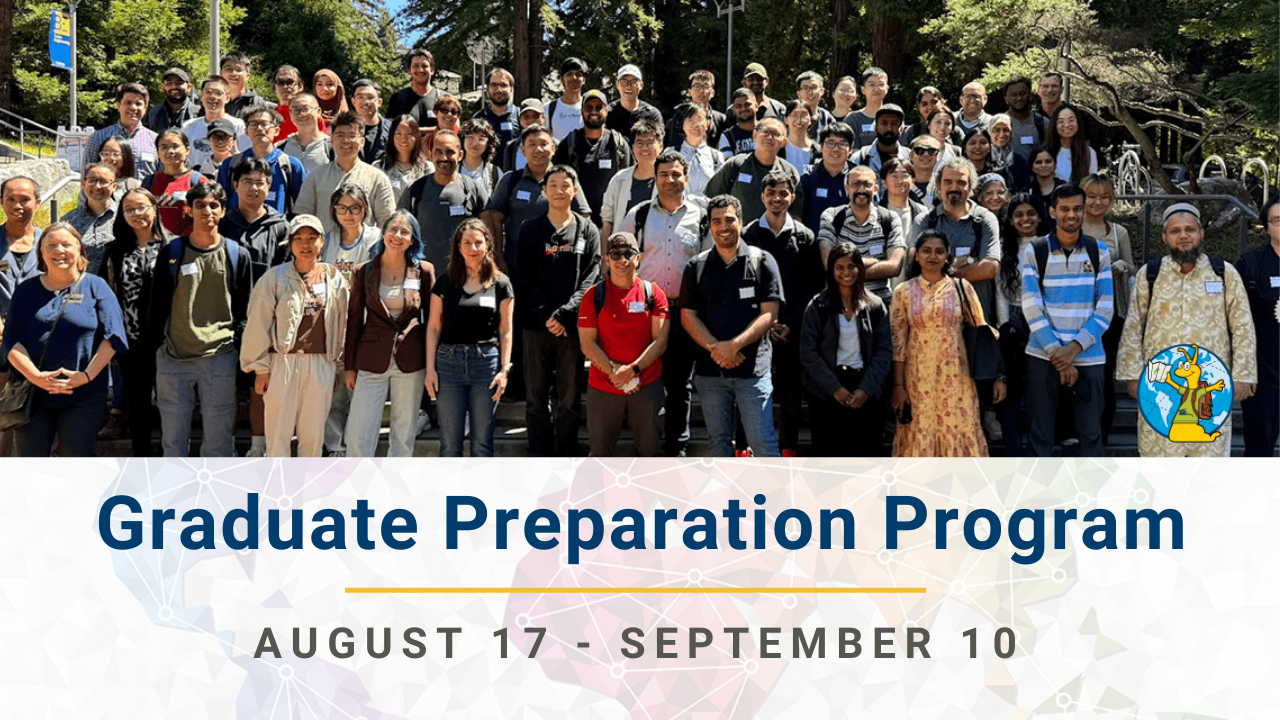
  • Graduate Preparation Program

    The Graduate Preparation Program (GPP) is a four-week intensive non-credit course offered in person on the main campus prior to the fall quarter, which is open to all current and […]

    $1275
  • Nikolakakis, M. (ECE) – Learned Gridless Representations of Cone Beam Computed Tomography Scans

    Engineering 2 Engineering 2 1156 High Street, Santa Cruz, CA
    Hybrid Event

    Medical image representation has long been dominated by voxel-grid matrices. While their inherent structure and order work efficiently for various linear transformations and provide a seamless visualization method on monitors, they fail to preserve the topology of the scan and to encode sparse information in a memory-efficient way.   The recent emergence of machine learning-based continuous coordinate-based […]

  • Condon, C. (BMEB) – Genomic conflict across scales

    Biomedical Sciences Building 575 McLaughlin Drive

    Genomes are often viewed as cooperative systems in which genes work together to support organismal function. Yet genetic elements can also act in ways that favor their own transmission or […]

  • Build better chips

    Silicon Valley Campus 3175 Bowers Avenue, Santa Clara, CA, United States

    Join us for an interactive discussion on current industry trends, emerging skills, and career opportunities, and learn how our Silicon Chip Design & Semiconductor Engineering courses are designed to help professionals build expertise, stay competitive, and achieve their educational and career goals. Whether you’re looking to advance in your current role, transition into a new field, or […]

  • Lupin-Jimenez, L. (AM) – Data-Driven Deep Learning for Turbulent Phenomena: Regional Ocean Prediction and Assimilation, Spectral Bias in Diffusion Models, and Equation Discovery

    Engineering 2 Engineering 2 1156 High Street, Santa Cruz, CA
    Hybrid Event

    Deep learning models trained on simulation and reanalysis data can now emulate turbulent geophysical flows at a small fraction of the computational cost of numerical solvers. Their scientific utility depends on physical consistency, which for the systems studied here rests in large part on spectral fidelity, the accurate reconstruction of variance across spatial scales. This […]

  • Penunuri, G. (BMEB) – Genomic, Proteomic, and Computational Approaches to the Study of Host-Microbe Systems

    Biomedical Sciences Building 575 McLaughlin Drive
    Hybrid Event

    Host-microbe systems are core to some of biology’s most consequential interactions, from the pathogens that drive infectious disease to symbionts affecting agricultural pest control and vector-borne disease transmission. Yet unlike the model organisms that have driven most of modern molecular biology, the microbes at the center of these interactions are rarely genetically tractable: many cannot […]

  • Become a Special Education Teacher Assistant

    Silicon Valley Campus 3175 Bowers Avenue, Santa Clara, CA, United States

    Interested in becoming a Special Education Teacher Assistant? Join us for an informative session to explore the courses designed to prepare you for success in inclusive and special education classrooms. We’ll provide an overview of the curriculum, discuss current industry trends and workforce demand, highlight career opportunities, and answer your questions about getting started. Your […]

  • How to Apply to the Premed Postbacc Program

    Silicon Valley Campus 3175 Bowers Avenue, Santa Clara, CA, United States

    Join UC Santa Cruz Healthcare Pathways for a live online information session to learn about our Premed Postbacc Cohort, Premed and Pre-Health DIY Pathways, and other program offerings. We’ll provide an overview of our programs and cover how to apply for our next admissions cycle, which opens August 7. We’ll also discuss the application process, admissions timeline, […]

  • Nava, A. (AM) – Machine-Learning Methods for Prediction of Biological Systems

    Engineering 2 Engineering 2 1156 High Street, Santa Cruz, CA
    Hybrid Event

    Advances in microscopy have enabled the collection of high-quality single-cell datasets, providing new opportunities to identify the mechanisms underlying complex biological processes. In this work, we develop machine-learning frameworks using single-cell temporal data with the goal of predicting and providing insights into these mechanisms. We produce frameworks for two biological systems, bacterial spore germination, the […]

  • Huang, X. (CSE) – Scalable and Verifiable Reasoning for Medical Foundation Models

    Virtual Event

    This PhD research focuses on developing reliable medical foundation models capable of reasoning across textual, visual, and interactive clinical information. The work investigates three complementary directions: improving medical reasoning through test-time scaling, training multimodal medical models with verifiable rewards, and synthesizing high-quality visual question-answering data from biomedical literature using generator-verifier frameworks. Building on these efforts, […]